
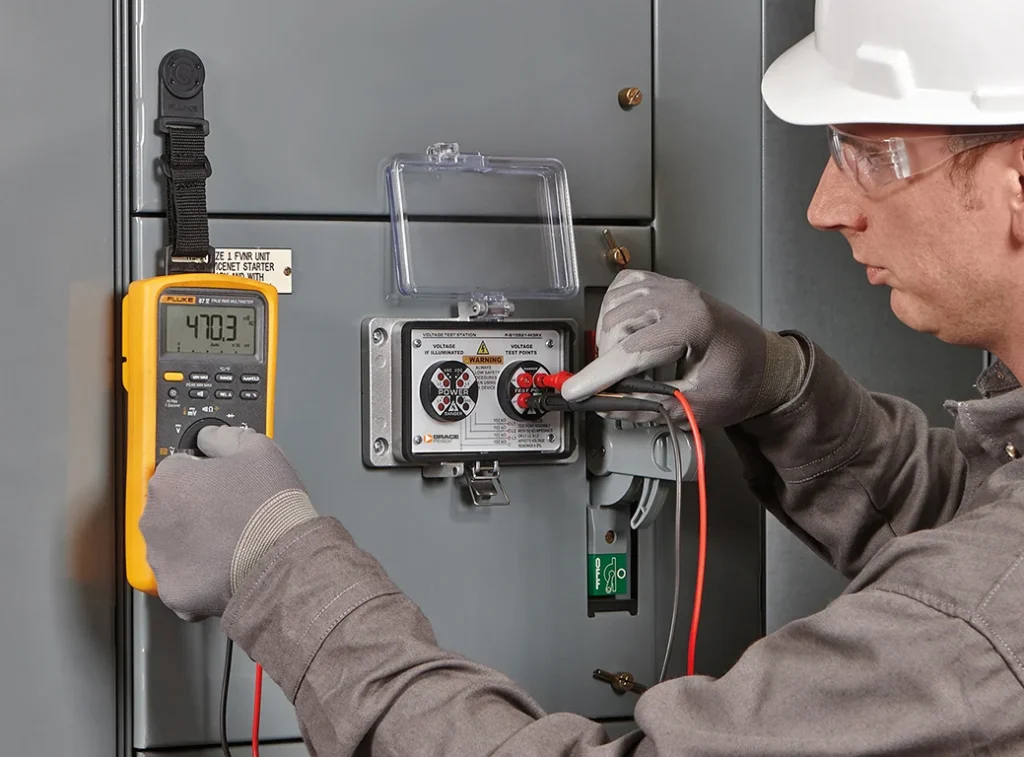
Electrical Inspections, Tests and Audit
ELECTRICAL TESTING & ANALYSIS SERVICES
Medium Voltage (MV) Systems
- Insulation Resistance
- Dielectric Withstand (Hi-Pot)
- Partial Discharge
- Tan Delta (Dissipation Factor)
- Circuit Breaker
- Current Transformer (CT)
- Potential Transformer (PT) Testing:
- Protection Relay Testing
- Switchgear Testing
- Power Factor Testing
Low Voltage (MV) Systems
- Continuity Test
- Insulation Resistance Test
- Earth/Ground Resistance Test
- Loop Impedance Test
- RCD (Residual Current Device) Testing
- Polarity Test
- Voltage Drop Test
- Functional Testing
- Thermal Imaging
POWER QUALITY ANALYSIS SERVICES
Power Quality analysis provides a detailed report on the quality and health of electrical power being used by the client. It also provides Harmonic Analysis that states the effect of load on power and its effects on Power Factors. These details play an important and crucial role while designing maintenance schedules and planning shutdowns. The reports provide the client with the most deteriorated parts of systems which helps them to focus on relevant sections.
ELECTRICAL AUDIT SERVICES
An electrical audit evaluates an electrical system’s performance, safety, and efficiency. The outcome of an electrical audit typically includes the following key elements:
- Safety Assessment: Identification of Hazards: Detects potential electrical hazards such as faulty wiring, overloaded circuits, and non-compliant installations.
- Efficiency Evaluation: Energy Consumption Analysis: Reviews energy usage patterns and identifies areas where energy is being wasted.
- Power Factor Correction: Assesses power factor and provides recommendations to improve it, potentially reducing energy costs.
- System Reliability: Evaluates the reliability and stability of the electrical system.
- Load Balancing: Identifies imbalances in the system and provides solutions to distribute loads more evenly.
- Cost Savings: Identifies ways to reduce energy consumption and lower electricity bills.
- Maintenance Costs: Provides insights on reducing maintenance costs by identifying and addressing potential issues before they lead to failures.
- Regulatory Compliance: Ensures the electrical system complies with local and international standards and regulations.
- Technology Upgrades: Suggestions for upgrading outdated or inefficient equipment to newer, more efficient technologies.
- Renewable Integration: Recommendations for integrating renewable energy sources, such as solar or wind, into the existing system.
- Risk Identification: Identifies potential risks associated with the electrical system.
- Carbon Footprint: Provides information on the carbon footprint of the electrical system and ways to reduce it.